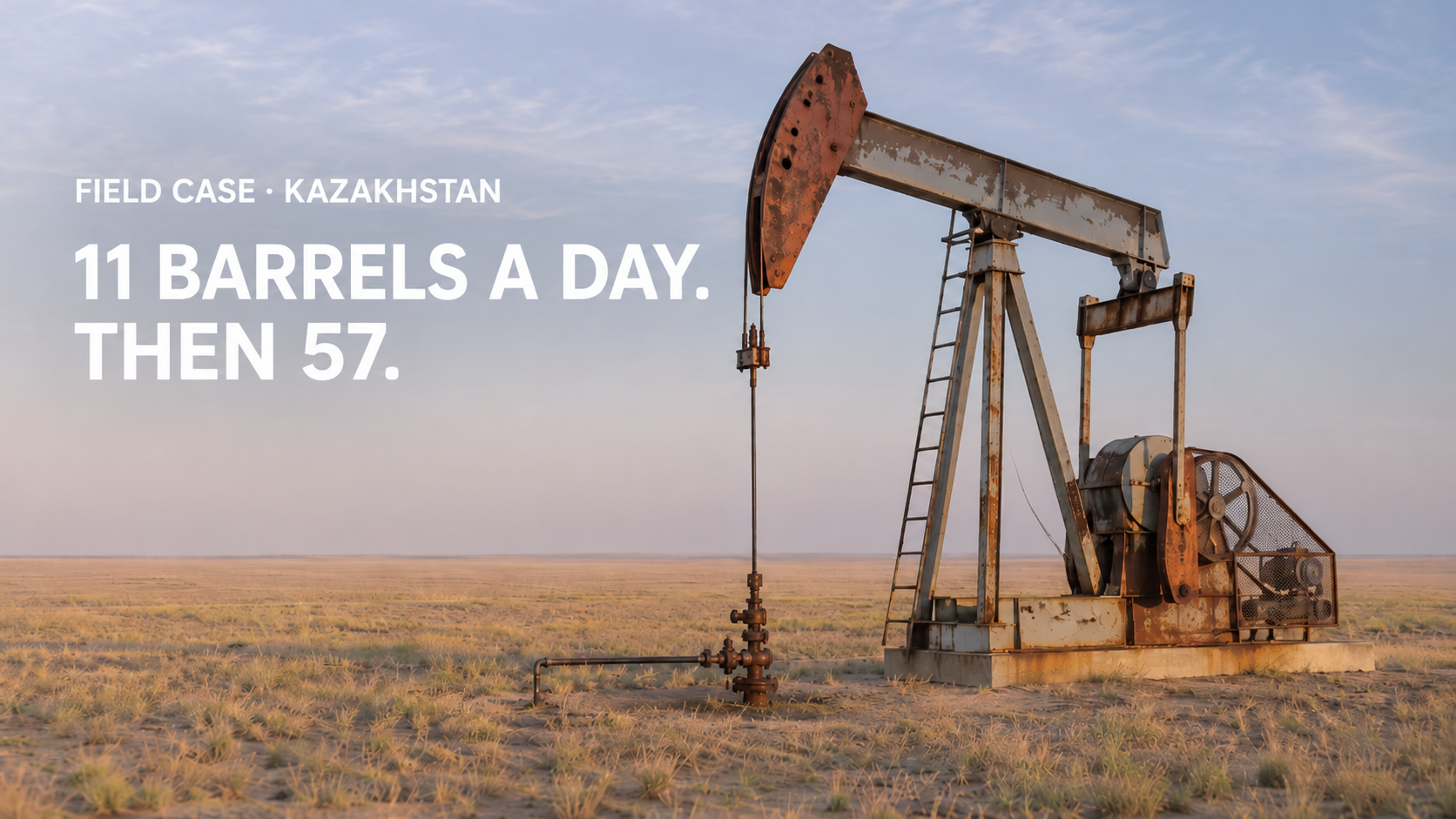
An 11 barrel per day rod-lift producer was returned to production on its existing pump. Nine days of measured data, and a plain account of what that does and does not establish.
The well
The well is a low-rate oil producer on sucker-rod lift in Kazakhstan. The operator has asked that the field not be named. In September 2026 it was producing approximately 11 barrels of oil per day.
Wells of this description rarely attract engineering attention. The volumes are small, the economics are thin, and the capital required to investigate them competes against drilling budgets that promise more. They are usually managed rather than studied.
That is the context in which this case is worth reading. Not because of the size of the response, but because of the kind of well that produced it.
An 11 barrel rod-lift producer is not an unusual well. In the United States it is the ordinary one.
The treatment
MPC near-wellbore stimulation was carried out on 24 and 25 October 2026. Approximately 478 barrels of formation water were placed in the near-wellbore zone as part of the treatment sequence.
MPC, or Multistage Physico-Chemical stimulation, is a patented in-wellbore thermal-chemical method. Three reagents are pumped sequentially and placed at the perforation interval, where a controlled exothermic reaction generates heat, gases, hydrogen and reactive vapours. The intent is to reduce near-wellbore damage, act on heavy organic restrictions and improve connectivity between the wellbore and the formation. Prestil Energy Ltd is the technology provider. All-In Energy Pro LLC is the commercialization and contracting partner in the United States.
The well was returned to production on 27 October, two days after the treatment concluded. It restarted on its existing sucker-rod pump. No new artificial lift was installed and no new surface equipment was required.
What was measured
By 1 November the reported oil rate was 57 to 61 barrels per day, against approximately 11 barrels per day before treatment.
Over the nine days from restart on 27 October to the assessment date of 4 November, the well produced approximately 482 to 493 barrels. Held at the untreated rate across the same period, it would have produced approximately 97 barrels. The measured difference is approximately 384 to 396 barrels.
Those figures are reported by Prestil Energy. They cover nine days.
What was projected
The same assessment carries forward projections of approximately 1,380 to 1,497 additional barrels over 30 days, 4,140 to 4,490 over 90 days, and 8,279 to 8,979 over 180 days, together with a ramp-up forecast of 66 to 101 barrels per day by mid-November.
Those numbers are arithmetic. They hold the recorded rate constant and assume no decline and no downtime across the projection period.
The projections are arithmetic, not production.
That assumption is worth stating plainly rather than leaving in a footnote. A well three weeks past a stimulation treatment has not demonstrated a decline profile, and a forward projection that assumes none is a calculation of what would happen if nothing changed, not a forecast of what will. The measured nine days and the projected six months should not be read as the same class of information.
Why the well type matters in the United States
The transferable part of this case is not the multiple. It is the well.
The EIA counted 918,481 producing oil and gas wells in the United States, of which approximately 78 percent produce 15 barrels of oil equivalent per day or less. Sucker-rod lift is the dominant artificial lift method across that population. A low-rate rod-pumped producer with a long operating history is not an edge case in American basins. It is the modal well.
Three operational details carry across more usefully than the rate change:
- The well returned to production on its existing pump. For an operator weighing an intervention against a plugging decision, the equipment question is usually the first one asked, and the answer here was that no new lift was required.
- The treatment occupied two days, with the well back online on the third. That is an intervention window a small operator can schedule against an existing workover or coiled-tubing slot.
- The baseline was documented before the work began. Without a pre-treatment rate there is no measurable response, only an assertion.
When the profile is worth evaluating
A well may merit a technical screen where several of the following hold:
- It once produced materially more than it does today
- The decline traces to damage rather than depletion
- Prior stimulation gave a short response, or none
- The oil carries paraffin, asphaltene or heavy fractions
- The reservoir retains pressure and remaining reserves
- A credible production baseline exists or can be established
MPC is not a fit for fully depleted reservoirs, for wells with unresolved casing or cement integrity issues, or for reservoirs where the constraint is capacity rather than damage. Screening exists to identify those cases before capital is committed, and a review that cannot return a negative answer is not a screen.
All-In Energy Pro LLC is the United States commercialization partner and sole operator-facing contracting party for the MPC Method. Pilots are best-efforts technical evaluations. No production outcome is guaranteed.
Operators evaluating mature or underperforming wells can begin a confidential candidate review with production history and well parameters: mpc@allinenergy.pro.